What Is a Smart Sprinkler Controller?
If you’ve ever come home to find your sprinklers running in the middle of a rainstorm, you already understand why smart sprinkler controllers exist.
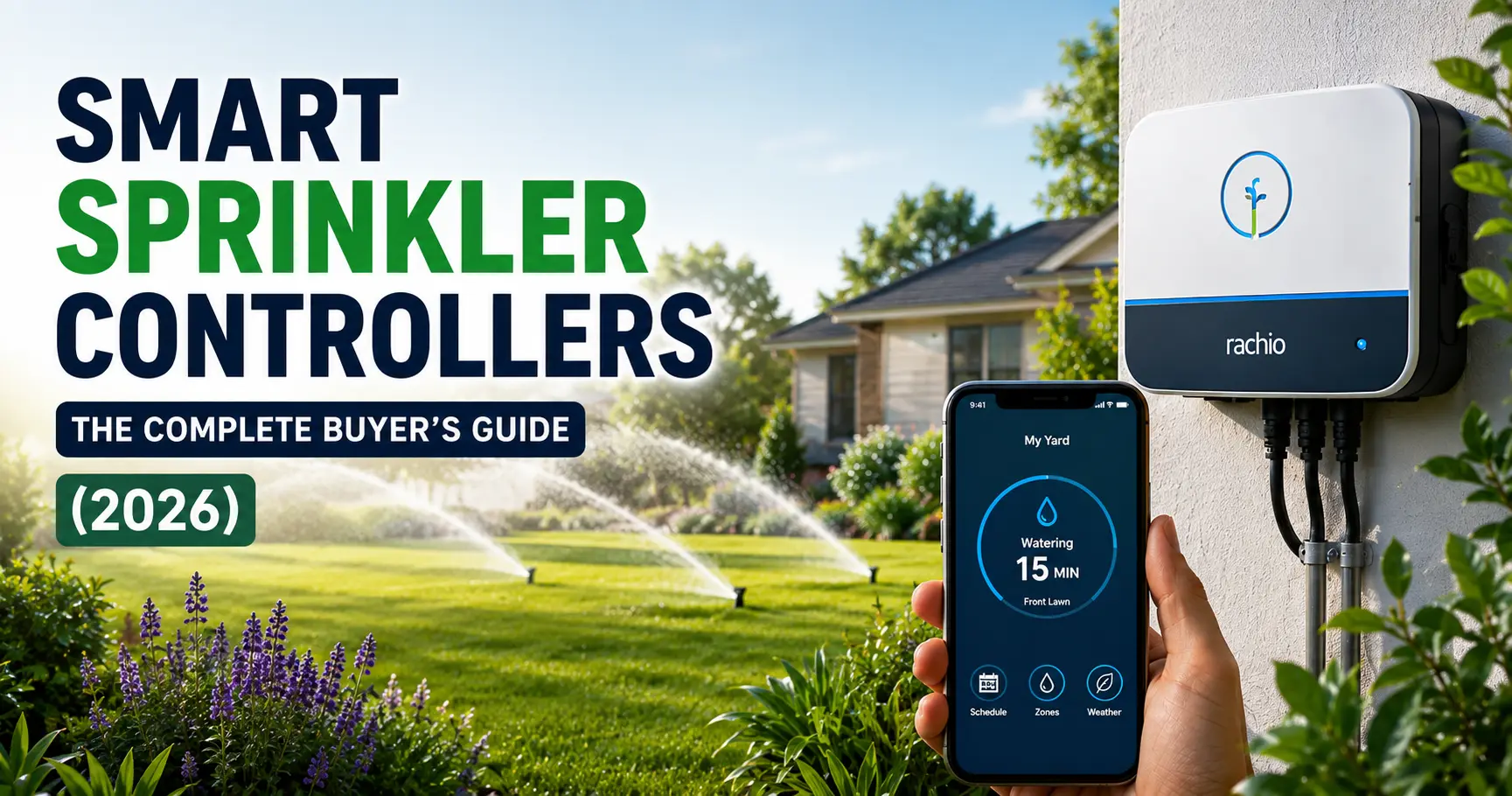
A smart sprinkler controller is a Wi-Fi-enabled device that replaces your traditional irrigation timer. Instead of running on a fixed schedule, it uses real-time weather data, soil moisture levels, and even satellite imagery of your lawn to water only when — and only as much as — your yard actually needs.
Think of it as the difference between a thermostat that cranks heat at 6 AM no matter what and a smart thermostat that reads the room. The same logic applies here.
Smart sprinkler controllers connect to your home network, sync with local weather stations, and can be controlled remotely via a smartphone app. Many also integrate with Google Home, Amazon Alexa, and Apple HomeKit — making them a natural fit for any smart home setup.
For U.S. homeowners, where the EPA estimates that 30% of all residential water use goes to landscaping, these devices aren’t just convenient — they’re genuinely impactful.
How Do Smart Sprinkler Controllers Work?
The Core Technology
At their heart, smart sprinkler controllers are connected irrigation timers with smarter brains. You install the controller in place of your existing timer (it wires into the same zone connections), then connect it to your home Wi-Fi. From there, the device does the heavy lifting.
Most use one or more of these data inputs:
- Weather-based scheduling (ET watering): Uses evapotranspiration data — a calculation of how much water plants lose through evaporation and transpiration — to build a watering schedule that matches actual conditions.
- Rain skip / rain delay: The controller automatically skips a watering cycle if rain is detected or forecast.
- Soil moisture sensors: Some controllers pair with underground sensors to water only when the soil moisture drops below a set threshold.
- Hyperlocal weather data: Controllers like Rachio and RainBird pull data from the nearest personal weather station (often through the Weather Underground network), not just the nearest airport.
A Common Scenario
Here’s how it plays out in practice: You set up your lawn zone in the app, input your grass type, sun exposure, and soil type. The controller calculates a baseline schedule. Then, on a day when temperatures hit 95°F and humidity is low, it automatically increases the runtime. When Thursday’s forecast shows rain, it skips Friday’s cycle entirely. You never touch it again — unless you want to.
Key Features to Look For
Not all smart sprinkler controllers are built the same. Here’s what separates a genuinely useful device from a glorified timer with a Wi-Fi chip:
Weather Intelligence
This is the most important feature. Look for controllers that use ET-based watering or pull data from hyperlocal weather stations. Generic zip-code weather is less reliable than data pulled from stations within a mile or two of your yard.
Number of Zones
Most residential systems run between 4 and 16 zones. Count your current zones before buying — and consider whether you might add more. Rachio’s 16-zone controller, for example, is ideal for larger properties.
App Quality and Reliability
You’ll interact with this device primarily through an app. Check recent reviews specifically about app stability, not just the hardware. A controller is only as good as the software running it.
Third-Party Integrations
If you use Google Home, Amazon Alexa, or Apple HomeKit, confirm compatibility before purchasing. Most top-tier controllers support all three, but budget models may skip Apple HomeKit entirely.
Flow Meter Compatibility
High-end controllers like Rachio 3 support optional flow meters that detect leaks in real time — a feature that can pay for itself after one broken irrigation head.
Best Smart Sprinkler Controllers of 2026
The market has matured significantly. Here are the controllers consistently rated at the top by landscaping professionals and homeowners alike:
Rachio 3 — Best Overall
Rachio remains the gold standard. Its Weather Intelligence Plus feature pulls from multiple hyperlocal sources, and the app is genuinely one of the best in class. Available in 8- and 16-zone versions. It supports Alexa, Google Home, and Apple HomeKit, and the flow meter add-on makes it the most comprehensive residential option available.
Best for: Homeowners who want the most accurate weather-based watering with minimal manual adjustment.
RainBird ST8I-WiFi — Best for Existing RainBird Systems
If you already have a RainBird irrigation system, this controller integrates seamlessly. It’s slightly less intuitive than Rachio’s app, but the hardware reliability is exceptional — RainBird has been building irrigation systems for over 85 years.
Best for: Homeowners upgrading an existing RainBird setup.
Orbit B-hyve XR — Best Budget Pick
The B-hyve XR punches well above its price point. It supports weather-based watering and integrates with Alexa and Google Home, though its Apple HomeKit support is more limited. The app has improved significantly in recent years.
Best for: Cost-conscious buyers who still want weather-responsive watering.
Netro Spark — Best for Small Yards
Netro’s Spark controller is compact, easy to set up, and excellent for properties with fewer zones (it maxes out at 12). Its AI-based watering algorithm adapts over time based on your yard’s actual response.
Best for: Apartment complexes, small residential lots, or users who want a low-maintenance set-and-forget experience.
WiFi vs. Non-WiFi Sprinkler Controllers: What’s the Difference?
This is one of the most common questions homeowners ask, so it’s worth being direct about it.
Traditional (non-WiFi) controllers work on fixed schedules you program manually. They’re reliable and inexpensive, but they water on Tuesday and Saturday whether it’s dry or flooded.
WiFi sprinkler controllers connect to your home network and the internet. This unlocks:
- Remote access via smartphone
- Automatic weather-based schedule adjustments
- Leak detection (with compatible flow meters)
- Usage history and reporting
- Voice assistant integration
The trade-off is cost and setup complexity. A quality wifi sprinkler controller runs $80–$250, compared to $20–$60 for a basic timer. But the EPA estimates smart controllers can reduce outdoor water use by up to 50% in some climates — which translates to real savings on water bills.
In practice, most homeowners in water-scarce regions — the Southwest, California, Texas — recoup the cost within a single summer season.
How Much Water Can You Actually Save?
Let’s talk numbers, because this is where smart sprinkler controllers make their strongest case.
According to the EPA’s WaterSense program, the average U.S. household uses about 9 gallons of water per day for outdoor use — but many use significantly more. WaterSense-labeled smart controllers are independently certified to save at least 15% more water than conventional timers.
In real-world testing by Rachio (published in their 2023 water savings report), homes using their controllers saved an average of 30–40% on irrigation water compared to fixed-schedule timers. That’s meaningful — both environmentally and financially.
For a lawn that uses 50,000 gallons per season, a 35% reduction equals 17,500 gallons saved. At typical U.S. water rates, that’s roughly $50–$100 back in your pocket each year — and more in drought-prone markets where tiered pricing kicks in.
Beyond cost, smart sprinkler controllers also prevent overwatering damage. A common scenario landscapers see repeatedly: lawns with root rot, fungal disease, and compacted soil caused by chronic overwatering on fixed schedules. Switching to weather-based watering corrects these problems within a season.
Installation: Is It Really DIY-Friendly?
For most homeowners with a standard irrigation setup, yes — installation is genuinely manageable in 30–60 minutes.
What You’ll Need
- A flathead and Phillips screwdriver
- Your existing irrigation controller’s wiring diagram (or a photo of it before you disconnect anything)
- A Wi-Fi connection within range of your controller location
The Basic Process
- Turn off power to your existing controller.
- Label and photograph all your existing wires before disconnecting.
- Mount the new controller (most use the same wall mounting footprint).
- Connect the wires to the corresponding terminals (COM, zones 1–N, MV/Master Valve if applicable).
- Power on and follow the app’s setup wizard.
The most common complication is identifying the common wire (usually white), which some older systems lack. Rachio and Orbit both offer support resources for this specific issue.
If your system uses more than 24 volts or has commercial-grade components, professional installation is worth the investment.
Smart Sprinkler Controllers and Smart Home Integration
One of the underrated benefits of the best smart sprinkler controllers is how naturally they fit into a broader smart home ecosystem.
Voice Control
With Alexa or Google Home linked, you can say “Alexa, run the front lawn zone for 10 minutes” — handy when you’re planting something and don’t want to walk back inside.
IFTTT and Automation Triggers
Many controllers support IFTTT (If This Then That) or direct API access. This opens up possibilities like:
- Automatically watering after a fertilizer application reminder
- Skipping a cycle when an outdoor motion sensor detects it’s raining
- Sending a notification when a zone completes its cycle
Home Automation Platforms
For users running Home Assistant or SmartThings, Rachio and Orbit both have well-maintained integrations. Rachio’s public API is particularly developer-friendly, making it a favorite in the smart home enthusiast community.
Common Mistakes to Avoid
Even with the best smart sprinkler controller on the market, setup errors can undermine the benefits. Here are the ones that come up most often:
1. Not entering accurate zone settings. The controller needs to know your grass type, soil type, sun exposure, and slope for each zone. Leaving these at defaults dramatically reduces the accuracy of weather-based scheduling.
2. Overriding the smart schedule constantly. If you’re manually adjusting every week, you’re defeating the purpose. Trust the algorithm — it typically takes 2–3 weeks to fully calibrate.
3. Ignoring flow meter alerts. If your controller supports leak detection and you’ve added a flow meter, set up push notifications. A broken head can waste hundreds of gallons before your next scheduled check.
4. Installing in direct sunlight without a weatherproof enclosure. Most controllers are rated for indoor or covered outdoor installation only. Check the IP rating before mounting in an exposed location.
5. Forgetting the rain sensor bypass. If you have an old rain sensor hardwired into your system, make sure it’s properly integrated with the new controller — or bypassed if the controller handles rain delays natively.
FAQ
Q: What is the best smart sprinkler controller in 2026? A: The Rachio 3 is the top-rated smart sprinkler controller for most homeowners. It offers hyperlocal weather intelligence, broad smart home compatibility, and an excellent app. The Orbit B-hyve XR is the best budget alternative.
Q: Do smart sprinkler controllers work with any irrigation system? A: Most smart sprinkler controllers are compatible with standard 24V AC residential irrigation systems. They replace your existing controller using the same wire terminals. Commercial systems with different voltage requirements may need professional assessment.
Q: How much do WiFi sprinkler controllers typically cost? A: WiFi sprinkler controllers range from about $80 for entry-level models to $250+ for premium options with advanced features like flow meter support. Installation is usually DIY, so there’s no additional labor cost for most homeowners.
Q: Will a smart sprinkler controller work if my Wi-Fi goes down? A: Yes. Most smart sprinkler controllers store a local schedule and continue running it if the Wi-Fi or internet connection is lost. You’ll lose remote access and weather updates until connectivity returns, but watering won’t stop entirely.
Q: Can a lawn sprinkler controller save money on my water bill? A: Absolutely. The EPA’s WaterSense program certifies that qualifying smart controllers save at least 15% more water than conventional timers — and real-world savings often reach 30–40%, depending on your climate and current watering habits.
Q: How many zones do I need? A: Count the number of separate sprinkler circuits in your yard. Most residential homes have 4–8 zones. If you’re unsure, check your existing controller — the number of numbered wire terminals indicates your zone count.
Q: Is installation difficult for a smart sprinkler controller? A: For standard 24V residential systems, installation typically takes 30–60 minutes and requires only a screwdriver. The main step is labeling existing wires before disconnecting them. Most leading brands include detailed app-guided setup walkthroughs.
Also Read: Best Wireless Earbuds Under $200 (2024–2026 Guide)
Final Thoughts
Smart sprinkler controllers are one of the most practical smart home upgrades available right now — not because they’re flashy, but because they solve a real, recurring problem: wasted water and overworked lawns.
Here are the key takeaways:
- Weather-based watering is the most important feature to prioritize — it’s what separates a smart controller from a fancy timer.
- Rachio 3 leads the category for most homeowners; Orbit B-hyve XR is the best value pick.
- Installation is DIY-friendly for standard systems, typically under an hour.
- Water savings of 30–40% are realistic and well-documented, with meaningful impact on both water bills and lawn health.
- Smart home integration (Alexa, Google Home, HomeKit) adds genuine convenience without complicating the core function.
If you’re still running your yard on a timer you set in 2015, it’s time to upgrade. Your lawn — and your water bill — will thank you.