Introduction
There’s a particular kind of disappointment that comes from ordering a “Spanish stew” and getting something that tastes like it came from a tin. If you’ve ever had real cocido gallego — the hearty Galician chickpea, pork, and vegetable stew — you know exactly why typing “best cocido gallego near me” into Google feels like such a gamble in the UK. Restaurants serving authentic Galician cooking are thin on the ground outside a handful of cities, and “near me” searches don’t always surface the right places.
This guide is for UK-based readers who’ve tasted cocido gallego in Spain, at a family gathering, or on a food blog, and now want to track it down closer to home — or who are planning a trip to Galicia and want to know what to look for before they get there. We’ll cover what the dish actually is, why it’s hard to find in Britain, how to evaluate a restaurant claiming to serve it, and what your realistic options are, including making it yourself.
What Is Cocido Gallego, Exactly?
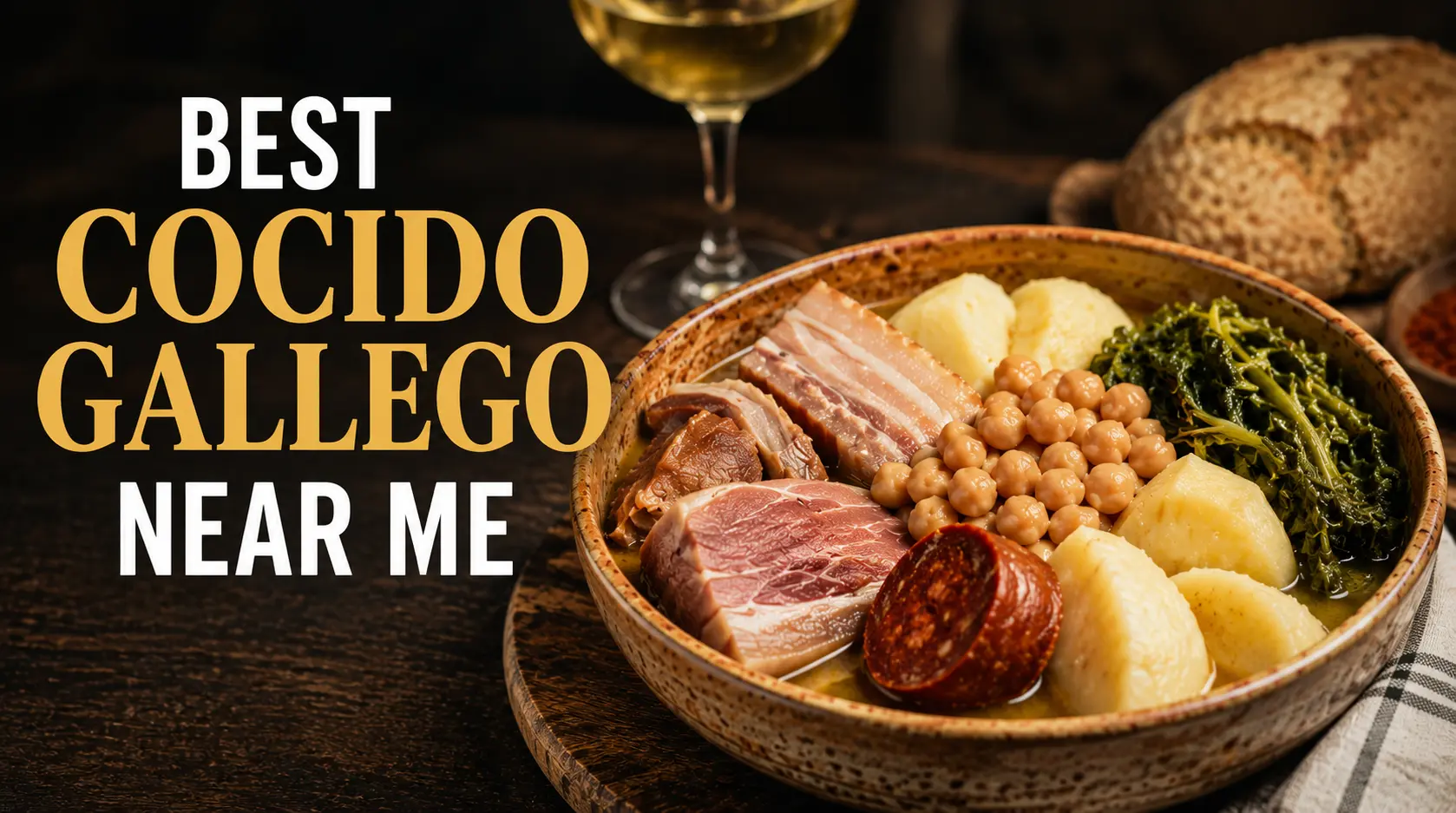
Cocido gallego is a traditional one-pot stew from Galicia, the rainy, green region in Spain’s northwest corner. At its core, it’s a slow-cooked combination of chickpeas, potatoes, and several cuts of pork — often including pork belly, ham bone, and chorizo — simmered with seasonal greens like grelos (turnip tops) or cabbage.
In practice, no two versions are identical. Every Galician family has its own ratio of meats to vegetables, and the dish is traditionally served in courses: the broth first, then the chickpeas and vegetables, and finally the meats. That staggered presentation is one of the clearest signs you’re eating the real thing rather than a simplified, Anglicised “Spanish stew.”
It’s worth distinguishing cocido gallego from cocido madrileño, the Madrid version of the dish. They share a chickpea-and-meat backbone, but the Galician version leans more heavily on pork products and leafy greens, while the Madrid version often includes thinner noodle soup as a starter course. If a UK menu just says “cocido” without specifying the region, it’s worth asking which tradition the kitchen is following — the flavour profile differs noticeably.
Also Read: Best Mojo Picón Potatoes Near Me (Canarian Wrinkled Potatoes with Spicy Red Pepper Sauce)
Why “Near Me” Searches Struggle With Niche Regional Dishes
Here’s what matters when you’re searching for something this specific: Google’s “near me” results are built primarily on proximity and listing data, not on dish-level accuracy. A restaurant can list “Spanish cuisine” in its Google Business Profile without ever putting cocido gallego on the menu, and it will still show up when you search the phrase.
A common scenario is this — you search “best cocido gallego near me,” get five results, and three of them turn out to be generic tapas bars that have never made the dish. This happens because:
- Search engines match keywords loosely. “Cocido,” “Spanish stew,” and “Galician food” often get treated as interchangeable by ranking algorithms, even though they’re not.
- Menus change more often than listings update. A restaurant might have served cocido gallego as a seasonal special two years ago and never removed the mention from an old blog post that still ranks.
- The UK has very few specialist Galician restaurants. Unlike Italian or Indian food, Galician cuisine doesn’t have the density of UK establishments needed for “near me” searches to work reliably.
You’ll notice this pattern with most regional, less mainstream dishes — the more specific the request, the less reliable proximity-based search becomes. Treat the search results as a starting point for research, not a verified answer.
How to Tell If a Restaurant’s Cocido Gallego Is Authentic
Based on real-world use of restaurant menus and reviews, there are a few reliable signals that separate a kitchen genuinely cooking Galician food from one using the name loosely.
Check the Ingredient List
Authentic cocido gallego should mention grelos or turnip greens, not just “cabbage,” and should list more than one type of pork product. A menu that simply says “chickpea and pork stew” without naming the components is often a simplified version.
Look for Galician or Northern Spanish Branding
Restaurants that genuinely specialise in this dish tend to identify as Galician specifically, not just “Spanish.” Look for references to Santiago de Compostela, the Rías Baixas, or Galician wines like Albariño on the wine list — these are strong indirect signals of regional focus.
Read Recent Reviews Carefully
Reviews mentioning the staggered three-course serving style, or comparing the dish to a specific Galician town’s version, are a good sign the kitchen takes the dish seriously. Vague five-star reviews calling it “lovely Spanish food” tell you very little.
Ask Before You Book
If you can, call ahead. A kitchen that makes cocido gallego properly — which takes hours of slow cooking — will usually need advance notice or only serve it on specific days. That’s actually a good sign, not an inconvenience.
Where UK Diners Are Most Likely to Find It
Galician and broader Spanish-regional restaurants in the UK are concentrated in a small number of areas, largely tied to Spanish expatriate communities and specialist food importers.
- London has the widest range of Spanish restaurants overall, and a small number focus specifically on Galician or northern Spanish cooking rather than generic tapas. These are the most likely to feature cocido gallego, often as a winter seasonal dish.
- Manchester and Liverpool have growing Spanish dining scenes, though Galician specialists are rare; cocido gallego is more likely to appear at pop-up events or Spanish cultural festivals than on a permanent menu.
- Edinburgh and Glasgow occasionally host Spanish food markets and festivals where a Galician stall may serve the dish, even when no permanent restaurant does.
Given how few dedicated Galician kitchens exist in the UK, it’s genuinely worth checking event listings for Spanish cultural associations, not just restaurant directories. Galician community groups in the UK sometimes organise seasonal cocido lunches that aren’t picked up by mainstream search at all.
What to Expect When You Order It
If you do find a place serving it, a few things are worth knowing going in. The portion is large by design — cocido gallego is meant to be a full, slow meal, not a starter. Expect it served in stages: broth first, often with thin noodles or rice added, followed by the chickpeas and greens, and finally a plate of the various meats.
It’s a winter dish by tradition, heavy and warming, which is partly why UK restaurants that do serve it tend to put it on seasonal menus rather than year-round ones. Don’t be surprised if it’s only available between roughly October and March.
Pricing in the UK tends to run higher than a typical stew dish, reflecting the cost of the meats and the long cooking time involved — this isn’t a dish that can be made quickly or cheaply, and a kitchen charging very little for it is worth a second look.
Making Cocido Gallego at Home as an Alternative
Given how limited UK restaurant options are, many people researching “best cocido gallego near me” end up cooking it themselves instead — and this is a genuinely reasonable alternative, not a consolation prize.
The core ingredients (chickpeas, pork belly, chorizo, potatoes, cabbage or kale as a grelos substitute) are all available in most UK supermarkets, with specialist Spanish ingredients like authentic chorizo and ham bones available from Spanish delicatessens or online importers. Soaking dried chickpeas overnight and simmering the meats slowly for several hours produces a far better result than rushing it.
This is also the most reliable way to guarantee authenticity. You control exactly what goes in, and you’re not depending on a restaurant’s interpretation of the dish matching your expectations.
Pairing and Serving: Getting the Full Experience
Traditionally, cocido gallego is paired with a Galician white wine, most commonly Albariño, which cuts through the richness of the pork. Some households serve a light red, like a young Mencía, particularly with the meat course.
For dessert, a classic Galician finish is tarta de Santiago, an almond cake that’s become widely available even outside Spain, including in some UK delis. If a restaurant serves cocido gallego and also has this on the dessert menu, it’s a reasonably good sign the kitchen has a genuine connection to Galician cuisine rather than a generalised “Spanish” theme.
Also Read: Best Guiso de Lentejas Near Me (Authentic Comfort Food Guide)
FAQ
Q: What’s the difference between cocido gallego and a regular Spanish stew? A: Cocido gallego is specifically Galician, built around chickpeas, multiple pork products, and grelos (turnip greens), and served in separate courses. Generic “Spanish stew” on a UK menu often simplifies or skips these regional details entirely.
Q: Why don’t more UK restaurants serve cocido gallego? A: It’s labour-intensive, requires specific ingredients not always stocked in the UK, and has a smaller audience than more familiar dishes like paella, so fewer kitchens commit to it regularly.
Q: Is cocido gallego available in the UK year-round? A: Rarely. It’s traditionally a winter dish, and most UK restaurants that serve it treat it as a seasonal item, typically available between autumn and early spring.
Q: Can I find cocido gallego at Spanish food markets or festivals in the UK? A: Yes, this is often more reliable than searching restaurant listings. Spanish cultural associations and community groups occasionally host cocido gallego events, especially around winter.
Q: Is it worth making cocido gallego at home instead of searching for a restaurant? A: Given how few specialist Galician restaurants exist in the UK, yes. With the right ingredients and several hours of slow cooking, a home version can be more authentic than what some restaurants serve.
Q: What should I look for to confirm a restaurant’s version is authentic? A: Check for named pork products, mention of grelos specifically, Galician wine options like Albariño, and reviews describing the staggered, multi-course serving style.
Q: Does cocido madrileño count as the same dish? A: No. It shares the chickpea-and-meat base but typically includes a noodle soup starter and leans less heavily on pork and greens than the Galician version.
Conclusion
Finding genuinely authentic cocido gallego in the UK takes more effort than a simple “near me” search can offer, mainly because the dish is niche, seasonal, and tied to a small number of specialist kitchens and community events. The key takeaways: verify ingredients and regional branding before booking, check seasonal availability, look beyond standard restaurant listings to food festivals and Spanish cultural groups, and consider making it at home if options near you are limited.
None of this means the search is hopeless — it just means treating “near me” results as a starting point rather than a verified guide. If you’ve found a UK spot that serves a genuinely authentic version, it’s worth sharing in the comments so other readers can track it down too. And if you’re curious about cooking it yourself, check out our step-by-step recipe guide linked above.